Human perception is naturally calibrated to the modest scale of our immediate daily lives. We measure distances in walking minutes, time in working weeks, and weight in kilograms. Yet our planet operates on a magnitude that defies ordinary human intuition. From subterranean fungal networks spanning whole mountains to subterranean abysses that could submerge Mount Everest, Earth is sculpted by extremes of physical scale, biological audacity, and monumental human engineering.
To contemplate the world’s grandest geographical features and living organisms is not merely an exercise in trivia; it is a profound cognitive recalibration. It reminds us of the delicate planetary balance that sustains life, the astonishing evolutionary leaps of the animal kingdom, and the enduring architectural will of human civilization.
Below, we examine the ten largest and longest wonders of the world across geography, biology, and human engineering—exploring their astonishing dimensions, ecological significance, and the historical science behind each extreme.
1. The Longest River System: The Nile vs. Amazon River Debate
The Scale: Approximately 6,650 km (Nile) vs. 6,400–6,992 km (Amazon).
The Phenomenon: For over a century, geographical orthodoxy crowned Africa’s Nile River as the undisputed longest river on Earth, flowing northward through eleven nations from Lake Victoria to the Mediterranean Sea. However, modern satellite telemetry, hydrological expeditions, and GIS mapping conducted by international researchers have challenged this title, tracing the Amazon River’s most distant headwaters to the glacial snowmelt of Nevado Mismi in southern Peru.
The Wonder Behind It: Regardless of which river edges out the narrow linear distance victory, the Amazon is unquestionably the largest river on Earth by discharge volume. The Amazon expels roughly 209,000 cubic meters of freshwater per second into the Atlantic Ocean—accounting for approximately twenty percent of total global river flow, out-discharging the next seven largest rivers combined.
2. The Longest Continental Mountain Range: The Andes (~7,000 km)
The Scale: Over 7,000 kilometers (4,350 miles) in continuous continental length.
The Phenomenon: Running unbroken along the western spine of South America, the Andes traverse seven sovereign nations: Venezuela, Colombia, Ecuador, Peru, Bolivia, Chile, and Argentina. With an average altitude of approximately 4,000 meters, its crowned peak, Mount Aconcagua in Argentina, surges to 6,961 meters (22,838 feet)—the highest point in both the Western and Southern Hemispheres.
The Wonder Behind It: Forged by the relentless tectonic subduction of the oceanic Nazca Plate beneath the South American continental plate, the Andes dictate the climate of an entire hemisphere. They create the hyper-arid Atacama Desert on their western rain shadow while capturing moisture from the trade winds to feed the vast Amazon Basin to the east.
3. The Largest Living Organism: Pando (“The Trembling Giant”)
The Scale: 106 acres (43 hectares), ~6,000 metric tons, 40,000+ interconnected stems.
The Phenomenon: Located in the Fishlake National Forest of Utah, Pando appears to the untrained eye as an expansive forest of individual quaking aspen trees (Populus tremuloides). In scientific reality, genetic analysis reveals that all forty thousand trees are clones belonging to a single, gigantic male organism connected by a massive underground root network.
The Wonder Behind It: Estimated to be between 9,000 and 14,000 years old, Pando is not only the heaviest known living organism on Earth, but among the oldest continuous life forms in existence. Whenever a single trunk dies of old age or disease, the shared root system simply shoots up a new genetically identical sucker, defying individual mortality through subterranean unity.
4. The Largest Animal in History: The Blue Whale (Balaenoptera musculus)
The Scale: Up to 30 meters (98 feet) in length; weighing up to 190–200 metric tons.
The Phenomenon: The Blue Whale is not merely the largest living animal today; it is the largest creature known to have ever lived in the entire 3.8-billion-year history of planet Earth—substantially surpassing the mass of the greatest Cretaceous sauropod dinosaurs.
The Wonder Behind It: The physiology of the blue whale strains belief. Its heart is the size of a golf cart, weighing roughly 180 kilograms and beating just two to eight times per minute during deep feeding dives. Its major blood vessels are wide enough for a human child to crawl through, and its tongue alone weighs roughly 2.7 metric tons—equivalent to an adult African forest elephant.
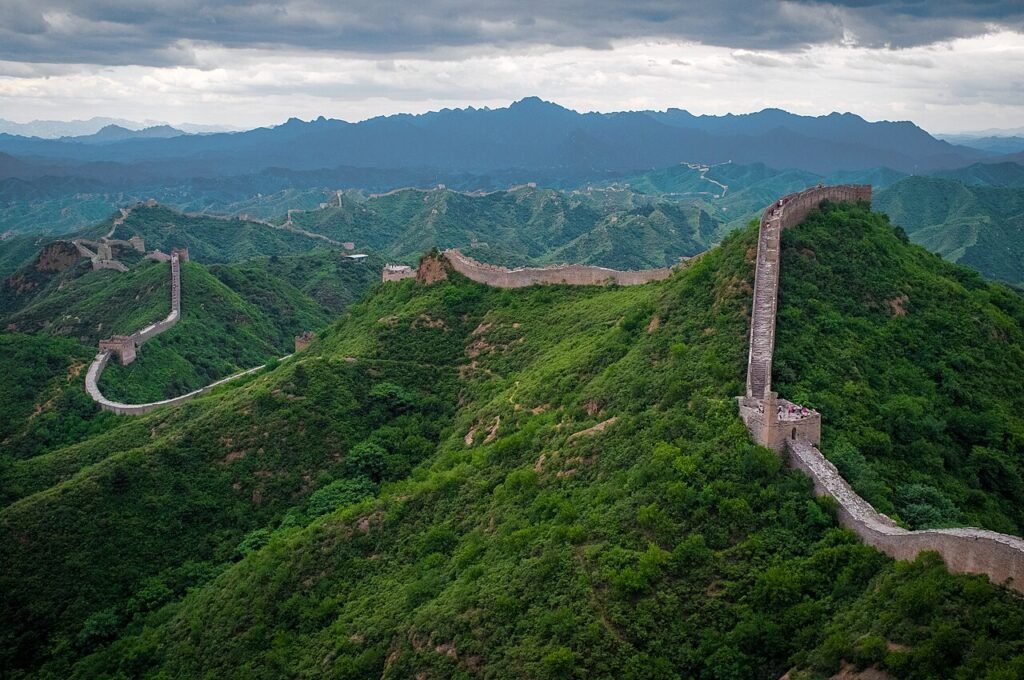
5. The Longest Human Architecture: The Great Wall of China (~21,196 km)
The Scale: 21,196 kilometers (13,171 miles) across all historical dynasties.
The Phenomenon: Begun as early as the 7th century BCE by warring states and unified under Emperor Qin Shi Huang in 221 BCE, the Great Wall of China represents the most colossal defensive engineering undertaking in human history. The iconic stone watchtowers and crenellated ramparts frequently photographed today were extensively fortified during the Ming Dynasty (1368–1644).
The Wonder Behind It: An official comprehensive archaeological survey conducted by China’s State Administration of Cultural Heritage measured all existing historical sections, including rammed-earth ramparts, trenches, natural defensive cliffs, and beacon towers. Together, they span over 21,000 kilometers across northern deserts, mountain ridges, and plateaus—more than half the circumference of the Earth.
6. The Largest Hot Desert on Earth: The Sahara (~9.2 Million km²)
The Scale: 9,200,000 square kilometers (3,552,000 square miles).
The Phenomenon: Covering roughly thirty-one percent of the entire African landmass, the Sahara Desert is virtually identical in geographic area to the United States or the People’s Republic of China. (While Antarctica and the Arctic are technically larger polar deserts, the Sahara is the undisputed king of hot deserts).
The Wonder Behind It: Contrary to popular mythology, the Sahara is not an endless sea of shifting sand dunes; only about twenty-five percent consists of sand seas (ergs). The remainder is comprised of windswept rocky plateaus (hamadas), barren gravel plains (regs), and volcanic massifs. Remarkably, climate cycle studies show that only 6,000 years ago, the Sahara was a lush green savannah crisscrossed by massive freshwater lakes and inhabited by hippopotamuses and pastoral communities.
7. The Longest Continuous Railway: The Trans-Siberian (9,289 km)
The Scale: 9,289 kilometers (5,772 miles) across 8 time zones.
The Phenomenon: Constructed between 1891 and 1916 under the supervision of Sergei Witte and Emperor Nicholas II, the Trans-Siberian Railway connects European Russia (Moscow’s Yaroslavsky station) to the Pacific port of Vladivostok on the Sea of Japan.
The Wonder Behind It: A non-stop journey on the primary *Rossiya* train takes approximately seven full days, traversing sixteen major rivers (including the Volga, Ob, Yenisei, and Amur), skirting the southern shores of Lake Baikal (the world’s deepest and oldest freshwater lake), and cutting through thousands of kilometers of virgin Siberian birch taiga.
8. The Largest Living Structure: The Great Barrier Reef (~2,300 km)
The Scale: Over 2,300 kilometers (1,430 miles) long; covering ~344,400 km².
The Phenomenon: Stretching off the coast of Queensland in northeastern Australia, the Great Barrier Reef is the world’s most extensive coral reef ecosystem, comprised of nearly 3,000 individual reef systems, 600 continental islands, and 300 coral cays.
The Wonder Behind It: Built over millions of years by tiny, soft-bodied organisms called coral polyps that secrete calcium carbonate skeletons, the Great Barrier Reef is so vast that it can be distinctly seen and photographed from Earth orbit. It serves as an oceanic sanctuary for thirty species of whales and dolphins, six species of marine turtles, and over 1,500 species of fish.
9. The Deepest & Longest Abyssal Trench: The Mariana Trench (~2,550 km)
The Scale: 2,550 kilometers long, 69 kilometers wide; depth of 10,994 meters.
The Phenomenon: Formed in the western Pacific Ocean along the subduction boundary between the Pacific and Mariana tectonic plates, the Mariana Trench is Earth’s ultimate abyssal frontier. Its deepest chasm, the *Challenger Deep*, plunges nearly eleven kilometers beneath the ocean surface.
The Wonder Behind It: If Mount Everest were set down into the Challenger Deep, its summit would still be submerged beneath more than two kilometers of water. At the bottom, the hydrostatic pressure exceeds 1,086 bar (over 15,700 pounds per square inch)—a crushing force equivalent to bearing the weight of fifty jumbo jets on a human chest, in pitch-black near-freezing water that nevertheless hosts unique extremophile organisms.
10. The Largest Subterranean Cave: Hang Son Doong (Vietnam)
The Scale: 38.5 million cubic meters of enclosed volume; up to 200m high & 150m wide.
The Phenomenon: Hidden beneath the limestone karst mountains of Phong Nha-Ké Bang National Park in central Vietnam, Hang Son Doong (“Mountain River Cave”) is officially recognized by the British Cave Research Association as the largest natural cave passage in the world.
The Wonder Behind It: Carved out by the subterranean Rao Thuong River over three million years, the cave’s primary passage is so cavernous that a modern 40-story city skyscraper could comfortably stand inside it. Portions of the ceiling collapsed millennia ago to form giant sinkholes (dolines), allowing sunlight to penetrate and nourish an internal jungle ecosystem complete with its own localized cloud systems.
Curated Book Vault: 4 Masterworks on Earth’s Natural Wonders
To cultivate a deeper scholarly appreciation for the physical extremes, geological forces, and biological wonders that define our planet, our editorial team recommends four timeless works:
A Short History of Nearly Everything — Bill Bryson
The quintessential layman’s guide to Earth’s origins, geological wonders, ocean depths, and the extraordinary chain of cosmic accidents that created our living world.
Explore on Amazon →The Hidden Life of Trees — Peter Wohlleben
A groundbreaking exploration into the subterranean fungal networks and social communication systems of forest giants like Pando and ancient woodland groves.
Explore on Amazon →The Map That Changed the World — Simon Winchester
The gripping story of William Smith, the surveyor who drafted the first geological map of an entire nation and unlocked the secrets of Earth’s subterranean strata.
Explore on Amazon →The Blue Machine: How the Ocean Works — Helen Czerski
Physicist Helen Czerski illuminates the physics and ocean currents driving the deep abyss, from the Mariana Trench to the Great Barrier Reef.
Explore on Amazon →Frequently Asked Questions
Which is officially the longest river: the Nile or the Amazon?
The Nile River (6,650 km) is traditionally recorded in encyclopedias as the longest river. However, modern satellite expeditions by Brazilian and international researchers measuring the Amazon from its most distant Peruvian glacial source measure it up to 6,992 km. While the linear distance remains debated, the Amazon is indisputably the largest river in the world by water volume.
Can the Great Wall of China really be seen from space?
Contrary to the popular urban myth, the Great Wall cannot be seen from low Earth orbit with the unaided human eye because it is relatively narrow (roughly 5 to 9 meters wide) and constructed from local stones and soil that blend with the surrounding landscape. It is only distinguishable with high-resolution satellite cameras or telephoto lenses.
What is the difference between the largest desert and the largest hot desert?
In geography, a desert is defined purely by low annual precipitation (typically under 250 mm annually), not temperature. Therefore, the polar ice sheets of Antarctica (14.2 million km²) and the Arctic (13.9 million km²) are technically the largest deserts on Earth. The Sahara (9.2 million km²) is the largest subtropical hot desert.
Deepen your intellectual curiosity with our explorations of why deep reading rewires the brain, our reflections in mindful living, and insightful essays in the Current Scholar journal.