To open a book written by a transformative thinker is to encounter human consciousness at its most fearless. Across centuries of human history, women have not merely participated in the world of ideas; they have radically redefined its architecture. Often writing against formidable societal resistance, systemic exclusion, and immense personal danger, pioneering women thinkers, scientists, essayists, and philosophers used the written word as an instrument of profound intellectual rebellion and moral clarity.
Their pages did not simply chronicle their times—they dismantled prejudices, founded modern scientific disciplines, sparked global ecological revolutions, and exposed the intricate depths of human psychology. Whether establishing the foundations of modern primatology in the forests of Gombe or articulating the necessity of intellectual autonomy in 1920s Cambridge, these authors altered how humanity perceives itself.
Below, we examine seven monumental books authored by history’s most influential women, pairing their singular historic achievements with the enduring philosophies etched into their landmark works.

1. Virginia Woolf: A Room of One’s Own (1929)
Historic Achievement: Central figure of the Bloomsbury Group, pioneering modernist novelist who revolutionized stream-of-consciousness narrative, and foundational architect of feminist literary theory and intellectual autonomy.
Delivered originally as a series of lectures at Newnham College and Girton College at Cambridge University, A Room of One’s Own is widely regarded as one of the most brilliant and enduring essays in the English language. Woolf bypasses sentimental rhetoric to examine a stark, material reality: intellectual freedom depends upon material independence. To create art, write literature, and engage in high philosophical contemplation, Woolf famously argued, a woman must possess “money and a room of her own.”
Through the fictionalized tragedy of Shakespeare’s equally gifted but utterly silenced sister, “Judith Shakespeare,” Woolf exposed how centuries of lost female genius were not due to lack of intellect, but the absence of quiet, privacy, and economic self-determination. Her insights remain foundational for anyone striving to carve out a creative sanctuary amidst the noise of societal obligation.
A Room of One’s Own — Virginia Woolf
An indispensable meditation on the necessary prerequisites for creative genius, solitude, and authentic intellectual freedom.
Explore on Amazon →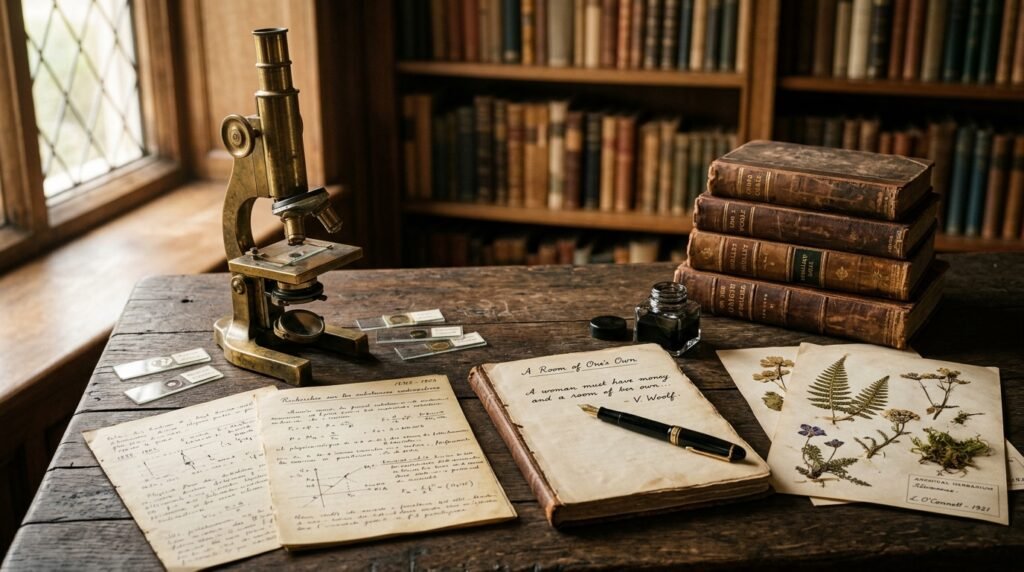
2. Marie Curie: Radioactive Substances & Autobiographical Notes
Historic Achievement: The first woman to win a Nobel Prize (Physics, 1903), the first person and only woman to win Nobel Prizes in two distinct scientific fields (Chemistry, 1911), discoverer of polonium and radium, and director of the Red Cross Radiology Service during World War I.
Marie Skłodowska Curie’s doctoral thesis, Recherches sur les substances radioactives (Investigating Radioactive Substances), and her subsequent personal writings chronicle one of the most astonishing triumphs of rigorous intellect in scientific history. Conducting arduous physical labor in a drafty, unheated wooden shed in Paris—personally boiling tons of pitchblende ore to isolate infinitesimal traces of radium—Curie revolutionized physics and overturned the ancient belief that atoms were indivisible.
Her autobiographical reflections reveal an unmatched ethical posture: she refused to patent the radium-isolation process, firmly believing that scientific discovery belongs to humanity rather than commercial profit. Her writings stand as an everlasting testament to quiet tenacity, absolute scientific integrity, and unyielding devotion to discovery.
Pierre Curie & Autobiographical Notes — Marie Curie
The firsthand memoir and scientific reflections of the woman whose laboratory tenacity unlocked atomic physics and changed medicine forever.
Explore on Amazon →3. Rachel Carson: Silent Spring (1962)
Historic Achievement: Marine biologist, writer for the U.S. Fish and Wildlife Service, National Book Award winner, posthumous recipient of the Presidential Medal of Freedom, and universally recognized founder of the modern global environmental movement.
Few single books in history can claim to have altered government policy, given birth to an international grassroots movement, and preserved countless human and non-human lives. When Rachel Carson published Silent Spring in 1962, she challenged the chemical industry’s unregulated use of synthetic pesticides such as DDT. Carson warned that indiscriminate chemical spraying was poisoning entire biological food chains, threatening avian populations with silent, songless springs, and seeping into human cells.
Facing vicious smear campaigns from chemical corporations attempting to discredit her credentials, Carson defended her research with unflinching scientific rigor before the United States Congress. Her courageous prose led directly to the nationwide ban on DDT and inspired the eventual creation of the U.S. Environmental Protection Agency (EPA). Silent Spring remains the gold standard of courage in science writing.
Silent Spring — Rachel Carson
The monumental, poetic exposé that ignited the modern environmental revolution and reminded humanity of the fragility of living ecosystems.
Explore on Amazon →4. Maya Angelou: I Know Why the Caged Bird Sings (1969)
Historic Achievement: Celebrated poet, civil rights activist who organized alongside Dr. Martin Luther King Jr. and Malcolm X, inaugural presidential poet for Bill Clinton, National Medal of Arts recipient, and one of the most revered autobiographers in American history.
In her debut memoir, I Know Why the Caged Bird Sings, Maya Angelou accomplished something unprecedented in 20th-century literature. Depicting her early life in the segregated American South—navigating the brutalities of racism, abandonment, and devastating childhood sexual assault—Angelou charted how literature, poetry, and a resilient spirit can rebuild a shattered voice. Following trauma, young Maya was mute for nearly five years; her subsequent recovery and mastery of the English language became a beacon of survival.
Angelou’s prose is lyric, unflinching, and transcendent. Her memoir proved that profound suffering does not have to dictate a human life; instead, through dignity and self-expression, the caged bird can transform its cry into an enduring anthem of hope and freedom.
I Know Why the Caged Bird Sings — Maya Angelou
A timeless masterpiece of American autobiography documenting the triumph of human dignity, literacy, and spirit over unspeakable hardship.
Explore on Amazon →5. Jane Goodall: In the Shadow of Man (1971)
Historic Achievement: World’s foremost primatologist, UN Messenger of Peace, Dame Commander of the Order of the British Empire (DBE), and pioneer who revolutionized ethology by redefining what it means to be human.
When 26-year-old Jane Goodall arrived on the shores of Lake Tanganyika in Gombe Stream National Park in 1960, the scientific establishment held a rigid, reductionist view of the animal kingdom. Animals were viewed as unfeeling biological automatons, and toolmaking was considered the exclusive defining trait separating humans from all other species on Earth.
Goodall’s patient, empathetic observation shattered those dogmas forever. Her groundbreaking work, In the Shadow of Man, documented that chimpanzees feel grief, forge complex social alliances, demonstrate altruism, and—most famously—strip leaves from twigs to fashion tools for termite fishing. When her mentor, paleoanthropologist Dr. Louis Leakey, received her telegram, he famously wrote: “Now we must redefine tool, redefine man, or accept chimpanzees as humans.” Goodall’s masterpiece dismantled human arrogance and inaugurated a gentler, more compassionate kinship with the natural world.
In the Shadow of Man — Jane Goodall
The gripping firsthand account of Goodall’s revolutionary years in Gombe that forever transformed our understanding of animal intelligence and human nature.
Explore on Amazon →6. Mary Wollstonecraft: A Vindication of the Rights of Woman (1792)
Historic Achievement: 18th-century Enlightenment moral philosopher, educator, and foundational theorist whose razor-sharp prose established the intellectual framework for universal human rights.
Written in just six weeks amidst the philosophical upheaval of the French Revolution, Mary Wollstonecraft’s A Vindication of the Rights of Woman was a radical challenge to European Enlightenment thinkers like Jean-Jacques Rousseau, who argued that women should only be educated to please men. Wollstonecraft countered with formidable philosophical precision: if reason is the divine spark that defines human morality, then reason is universal and has no sex.
She maintained that denying girls rigorous scientific, philosophical, and physical education produced superficiality by design—and then falsely blamed women for the very limitations society imposed on them. Wollstonecraft’s courageous treatise was centuries ahead of its time, providing the intellectual blueprint that fueled subsequent generations of educators, scholars, and reformers across the globe.
A Vindication of the Rights of Woman — Mary Wollstonecraft
The fiery, brilliant Enlightenment text that argued with devastating logic for equal educational rigor and moral autonomy for women.
Explore on Amazon →7. Toni Morrison: Beloved (1987)
Historic Achievement: Winner of the Nobel Prize in Literature (1993), the Pulitzer Prize for Fiction (1988), the Presidential Medal of Freedom, and universally celebrated as one of the most sublime stylists in world literature.
When the Swedish Academy awarded Toni Morrison the Nobel Prize, they commended her for prose that “gives life to an essential aspect of American reality.” Nowhere is this visionary power more breathtakingly realized than in her 1987 masterpiece, Beloved. Inspired by the true story of Margaret Garner, an enslaved woman who escaped from Kentucky to Ohio in 1856, Morrison probes the unfathomable psychological toll of human bondage, maternal love, and unresolved historical trauma.
Blending haunting magical realism with an extraordinary command of biblical cadence, folklore, and internal monologue, Beloved achieved what conventional historical records could never manage: it gave voice to the unspeakable interior lives of those whose memories had been historically erased. It remains an essential monument of global literature.
Beloved — Toni Morrison
Morrison’s towering, Pulitzer Prize-winning reckoning with memory, historical trauma, and the fierce endurance of human devotion.
Explore on Amazon →The Common Thread: Intellectual Courage
What unites these extraordinary thinkers across eras, scientific fields, and creative disciplines is a shared refusal to accept inherited boundaries. Whether peering into pitchblende residues like Marie Curie, documenting chimpanzee emotional worlds like Jane Goodall, or articulating the necessity of creative quietude like Virginia Woolf, their writing proves that true literature is never passive.
To sit with these books is to engage in deep reading that nourishes the human mind and deepens our reverence for those who paved the way. Explore further reflections on literature, philosophy, and mindful attention in our Mindful Living Hub and the Current Scholar Journal.
Questions on History’s Most Influential Women Authors
Why are books by famous women throughout history so impactful?
These books reshaped foundational ideas in science, ethics, and art. Written often in the face of intense institutional barriers, works by authors like Rachel Carson, Virginia Woolf, and Marie Curie fundamentally altered public policy, scientific discovery, and human rights.
Which book by a woman launched the modern environmental movement?
Rachel Carson’s 1962 landmark book Silent Spring exposed the ecological hazards of synthetic pesticides such as DDT, leading directly to a national ban and the formation of the U.S. Environmental Protection Agency (EPA).
What was Virginia Woolf’s core message in A Room of One’s Own?
Woolf argued that intellectual and artistic achievement requires economic self-determination and private space—famously stating that to write fiction, a woman must possess financial autonomy and a room of her own.
Who was the first woman to win Nobel Prizes in two distinct sciences?
Marie Curie was the first woman to win a Nobel Prize (Physics in 1903) and remains the only person in history to win Nobel Prizes in two different scientific fields (Chemistry in 1911).