Across the living tapestry of planet Earth, the passage of biological time is neither uniform nor democratic. For an adult American mayfly, an entire lifetime of flight, courtship, and genetic transmission unfolds within a fleeting afternoon. For a Greenland shark cruising the icy abyss of the Arctic Ocean, that same span of time represents less than one-tenth of one percent of its slow, four-century existence. Contemplating the vastly disparate lifespans of Earth’s organisms forces us to confront the deepest questions of evolutionary biology: Why do living things age, why do some species live for centuries, and how does human longevity fit into nature’s grand design?

In classical biology, longevity was long considered a simple consequence of body mass and metabolic rate—an empirical pattern known as Kleiber’s Law. Yet modern cellular genetics and comparative zoology reveal that nature has evolved radically diverse strategies for biological endurance. From cellular transdifferentiation that resets aging to cold-adapted metabolic suppression and robust DNA repair mechanisms, life has conquered time in astonishing ways.
Below, we examine the complete spectrum of lifespans in animals, humans, and extraordinary living organisms, ranking nature’s creatures from ephemeral hours to multi-millennial longevity and biological immortality.
1. The Biological Pacing of Time: The Heartbeat Hypothesis
For more than a century, physiologists noticed a fascinating mathematical regularity across warm-blooded mammals: the “Living Fast, Dying Young” metabolic curve. In general, smaller mammals have rapid heart rates and elevated metabolic burns, whereas massive mammals have slow, measured pulses:
- Etruscan Shrew: Heart rate of roughly 1,000 to 1,500 beats per minute → Lifespan: 1 to 2 years.
- House Mouse: Heart rate of roughly 500 to 600 beats per minute → Lifespan: 2 to 3 years.
- African Elephant: Heart rate of roughly 30 beats per minute → Lifespan: 60 to 70 years.
- Blue Whale: Heart rate of roughly 4 to 8 beats per minute → Lifespan: 80 to 90 years.
When scientists multiply average heart rate by lifespan across almost all mammals, the mathematical product consistently hovers around 1.5 to 2 billion heartbeats per lifetime. However, humans are the extraordinary statistical outlier: thanks to advanced social cooperation, culture, hygiene, medicine, and unique evolutionary adaptations, modern humans achieve an unprecedented 3 to 3.5 billion heartbeats over an 80-year lifetime.
2. Ephemeral Lifespans: Measured in Hours and Weeks
At the shortest end of nature’s chronological spectrum, organisms have traded bodily maintenance for explosive, hyper-focused reproductive efficiency:
- The Mayfly (Order Ephemeroptera): 24 Hours (Adult Stage). While mayfly nymphs live underwater for up to a year, their adult winged phase lasts mere hours. Adult mayflies do not even possess functional mouthparts or digestive systems; their sole physiological purpose is to mate, lay eggs upon the water, and expire.
- Gastrotrichs: 3 to 4 Days. These microscopic, hair-like aquatic invertebrates inhabit marine and freshwater sediment. They reach sexual maturity within two days and complete their entire life cycle before the end of the week.
- Worker Honeybees: 4 to 6 Weeks (Summer). During the peak nectar foraging season, honeybees literally work their wings to exhaustion, burning out their flight musculature and metabolic reserves within 30 to 45 days. (Winter bees, in contrast, enter a semi-dormant state and survive up to six months).
- Fruit Fly (Drosophila melanogaster): 30 to 50 Days. The workhorse of laboratory genetics, the fruit fly accelerates through egg, larva, pupa, and reproductive adulthood in just over a month at room temperature.
3. Mammals & Domestic Companions: Decades of Affection
Mammalian lifespans reflect a delicate evolutionary trade-off between predation vulnerability and reproductive investment. Species subject to high environmental mortality (like rodents) invest energy into rapid, frequent litters rather than cellular repair, while apex species invest in extended lifespans:
- Rabbits: 8 to 12 years in domestic care (3 to 4 years in the wild).
- Domestic Dogs: 10 to 13 years on average. Interestingly, dogs invert the general rule of nature: larger breeds (Great Danes, Mastiffs) age significantly faster and live 7 to 9 years, while toy breeds (Chihuahuas, Toy Poodles) often reach 15 to 18 years due to lower early concentrations of the growth factor IGF-1.
- Domestic Cats: 12 to 18 years. The oldest verified cat in history, Creme Puff of Austin, Texas, lived an astonishing 38 years and 3 days.
- Horses: 25 to 30 years (with verified records exceeding 50 years).
- Chimpanzees: 40 to 50 years in protected sanctuaries (our closest living genetic relatives share our vulnerability to degenerative aging but rarely exceed six decades).
- African Elephants: 60 to 70 years. Elephants possess 20 copies of the tumor-suppressor gene TP53 (compared to only one copy in humans), granting them extraordinary resistance to cancer despite having millions of times more dividing cells.
4. The Human Lifespan Paradox: 80 to 120 Years
The human species (*Homo sapiens*) is an evolutionary marvel of longevity. While our Paleolithic ancestors faced high infant mortality and traumatic hazards that kept average life expectancy between 30 and 35 years, those who survived childhood routinely lived into their sixties and seventies.
Why did natural selection favor a prolonged human lifespan well beyond the female reproductive years? Anthropologists point to the “Grandmother Hypothesis”: post-reproductive women contributed vital caloric foraging and cultural knowledge to their grandchildren, dramatically increasing the survival of their genetic lineage. Today, modern sanitation, antibiotics, and medical science have elevated average global life expectancy to 73.4 years, with supercentenarians pushing the biological frontier:
- Global Average Life Expectancy: ~73 years (surpassing 84 years in nations like Japan, Switzerland, and Singapore).
- Verified Human Maximum Lifespan: 122 years, 164 days, achieved by Jeanne Calment of France (1875–1997).
- Biological Upper Bound: Biogerontologists estimate that without radical interventions in cellular epigenetic reprogramming, telomere restoration, and senescent cell clearance, the intrinsic thermodynamic limit of the human organism lies between 120 and 150 years.
5. Multi-Century Centenarians: Nature’s Cold & Armored Giants
When animals escape high predation and inhabit cold or high-pressure environments, biological time slows to an imperceptible crawl:
- Giant Tortoises (Galápagos & Aldabra): 150 to 250+ Years. Possessing heavy protective shells and extremely low basal metabolic rates, giant tortoises show virtually no signs of age-related physiological decline (negligible senescence). An Aldabra giant tortoise named *Adwaita* lived at the Alipore Zoological Gardens in Kolkata, India, to an estimated age of 255 years (1750–2006).
- Bowhead Whale (Balaena mysticetus): 200+ Years. Inhabiting icy Arctic waters, bowhead whales are the longest-living mammals on Earth. Scientists discovered stone harpoon points manufactured in the 1880s embedded deep inside the blubber of whales harvested in the 21st century. Genetic sequencing reveals unique duplications in the ERCC1 DNA repair pathway that make bowhead whales virtually immune to cancer and cardiovascular degeneration.
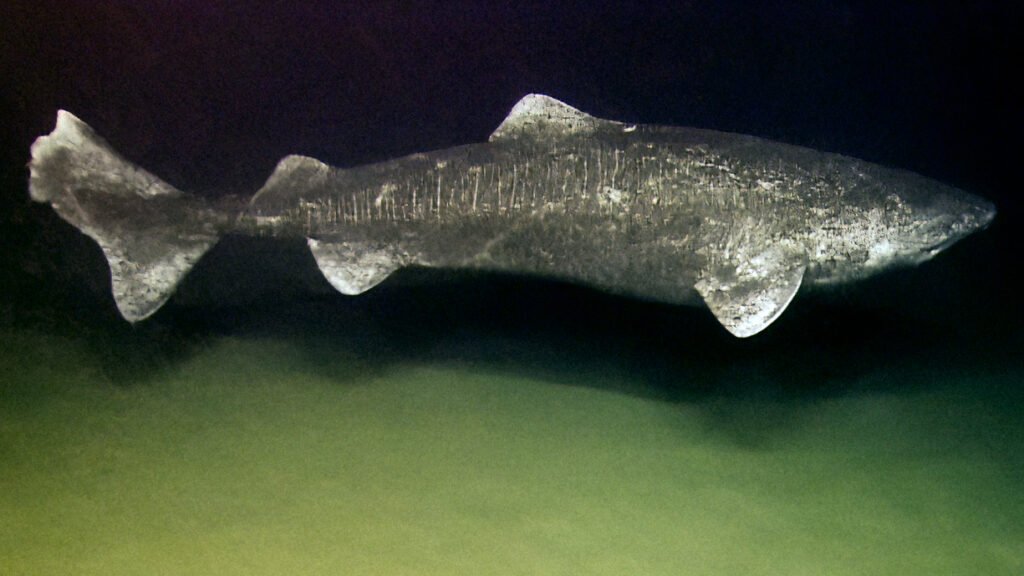
- Greenland Shark (Somniosus microcephalus): 272 to 500+ Years. In 2016, a groundbreaking study published in Science utilized radiocarbon dating of eye lens crystal proteins to measure the ages of 28 Greenland sharks. The largest female was estimated to be 392 years old (±120 years), meaning she was swimming through the dark North Atlantic waters during the reign of King James I and did not reach sexual maturity until she was approximately 150 years old.
- Ocean Quahog Clam (Arctica islandica): 500+ Years. In 2006, marine researchers off the coast of Iceland retrieved an ocean quahog clam nicknamed “Ming.” By counting the microscopic annual growth rings on its shell, sclerochronologists determined the mollusk was 507 years old, having begun its life in 1499 during the Ming dynasty.
6. The Immortals & The Millennial Flora
Beyond vertebrate animals lies a realm where chronological time loses all conventional meaning—organisms that can regenerate endlessly or plant colonies that have weathered entire geological epochs:
- The Immortal Jellyfish (Turritopsis dohrnii): Biologically Immortal. When stressed by injury, starvation, or old age, this tiny 4.5-millimeter hydrozoan does not die. Instead, it undergoes cellular transdifferentiation, transforming its mature specialized cells back into undifferentiated stem cells and reverting into a juvenile polyp colony. This biological time-loop can theoretically repeat indefinitely.
- Hydra (Hydra vulgaris): Negligible Senescence. Fresh-water hydras consist predominantly of continually dividing stem cells. Under optimal laboratory conditions, their mortality rate does not increase with age, making them effectively biologically immortal.
- Great Basin Bristlecone Pine (Pinus longaeva): 4,800 to 5,000+ Years. Perched high on the wind-blasted, arid dolomite cliffs of California’s White Mountains, ancient bristlecone pines grow at a glacial rate. A living specimen nicknamed “Methuselah” has survived for 4,855+ years, having germinated before the construction of the Great Pyramid of Giza.
- Pando Clonal Aspen Colony: 14,000 to 80,000 Years. Located in Utah’s Fishlake National Forest, Pando is a single male quaking aspen organism connected by an underground root system spanning 106 acres and weighing over 6,000 metric tons. While individual tree trunks live roughly 130 years, the subterranean root network has been renewing clones continuously since the end of the last Ice Age.
- Antarctic Glass Sponge (Anoxycalyx joubini): 10,000 to 15,000 Years. In the freezing, perpetually dark depths of the Southern Ocean, metabolic activity is so sluggish that individual specimen growth is almost unmeasurable, with some colonies estimated to have lived for over 11,000 years.
7. Master Lifespan Comparison: Nature Ranked
The comparative matrix below illustrates the vast span of biological time across kingdoms and domains:
| Organism / Species | Category | Average Lifespan | Maximum Documented | Key Biological Mechanism |
|---|---|---|---|---|
| Mayfly | Insect | 24 Hours (Adult) | 24 Hours | Vestigial digestive system; reproductive dash |
| House Mouse | Rodent | 1.5–2.5 Years | 4 Years | Extreme metabolic burn; high predation drive |
| Domestic Dog | Canine | 10–13 Years | 31 Years (Bobi) | IGF-1 growth factor signaling |
| Domestic Cat | Feline | 12–16 Years | 38 Years (Creme Puff) | Low basal metabolic rate; efficient renal system |
| African Elephant | Mammal | 60–70 Years | 86 Years (Lin Wang) | 20 copies of TP53 tumor-suppressor gene |
| Human (Homo sapiens) | Primate | 73.4 Years (Global) | 122 Years (Jeanne Calment) | Grandmother hypothesis; DNA repair; medicine |
| Galápagos / Aldabra Tortoise | Reptile | 100–150 Years | 255 Years (Adwaita) | Protective shell; negligible senescence |
| Bowhead Whale | Marine Mammal | 150–200 Years | 211 Years | ERCC1 & PCNA gene duplications |
| Greenland Shark | Chondrichthyes | 250–400 Years | 392±120 Years | Near-freezing metabolic suppression; slow growth |
| Ocean Quahog Clam | Mollusk | 200–400 Years | 507 Years (Ming) | Exceptional antioxidant membrane protection |
| Bristlecone Pine | Gymnosperm | 3,000–4,500 Years | 4,855+ Years (Methuselah) | Densely resinous rot-proof wood; extreme slow growth |
| Pando Aspen Colony | Clonal Plant | 10,000+ Years | 14,000–80,000 Years | Indefinite subterranean clonal root renewal |
| Immortal Jellyfish | Cnidaria | Biologically Immortal | Indefinite (Cyclical) | Cellular transdifferentiation (medusa to polyp) |
Curated Book Vault: 4 Masterworks on Longevity, Scale & Aging
To deepen your understanding of why living organisms age and how modern science is unlocking the molecular mechanisms of life extension, our editorial desk recommends four essential volumes:
Lifespan: Why We Age—and Why We Don’t Have To — Dr. David A. Sinclair
Harvard geneticist David Sinclair presents the revolutionary Information Theory of Aging, demonstrating how epigenetic erosion drives aging and how cellular reprogramming can restore vitality.
Explore on Amazon →Scale: The Universal Laws of Life, Growth, and Death — Geoffrey West
Theoretical physicist Geoffrey West unveils the stunning mathematical scaling laws governing the biological pace of life, metabolic heartbeats, and mortality across all living organisms.
Explore on Amazon →Outlive: The Science and Art of Longevity — Dr. Peter Attia
A definitive clinical blueprint addressing the chronic diseases of aging—heart disease, cancer, neurodegeneration, and metabolic dysfunction—to extend both lifespan and healthspan.
Explore on Amazon →Why We Die: The New Science of Aging and the Quest for Immortality — Venki Ramakrishnan
Nobel laureate Venki Ramakrishnan takes readers deep inside cellular physiology to examine DNA repair, mitochondrial decline, and the realistic evolutionary limits of human life.
Explore on Amazon →Frequently Asked Questions
What animal has the shortest lifespan on Earth?
The adult mayfly (order Ephemeroptera) has the shortest lifespan of any known animal. After spending up to a year as an aquatic nymph, the adult mayfly emerges solely to mate and lay eggs, living for just 24 hours or less without feeding.
What vertebrate animal lives the longest?
The Greenland shark (Somniosus microcephalus) is the longest-living vertebrate on Earth. Radiocarbon dating of eye lens proteins indicates these cold-water sharks live for at least 250 to nearly 400 years, growing at less than one centimeter per year in the Arctic Ocean.
Can any organism on Earth live forever?
The immortal jellyfish (Turritopsis dohrnii) is considered biologically immortal. When facing starvation, physical injury, or old age, it undergoes cellular transdifferentiation, transforming its mature cells back into stem cells and reverting into a juvenile polyp to begin its life cycle anew.
Why do smaller animals generally live shorter lives than larger ones?
According to metabolic scaling laws (Kleiber’s Law), smaller animals possess significantly higher heart rates and metabolic rates per gram of tissue. This rapid cellular combustion generates higher levels of oxidative stress and free radical damage, accelerating cellular wear and mortality.
Explore more planetary wonders in our Amazing World collection, read about Earth’s largest and longest wonders, or discover how deep reading calms the human nervous system.