Every meal consumed across our planet connects modern humans to a twelve-thousand-year chain of biological and technological ingenuity. Before the advent of agriculture, every waking hour of our hominid ancestors was tethered to the immediate metabolic quest for calories. The transition from nomadic foraging to deliberate soil cultivation was not merely an economic shift; it was the foundational pivot upon which all human civilization, cities, written legal systems, scientific inquiry, and philosophy were built.
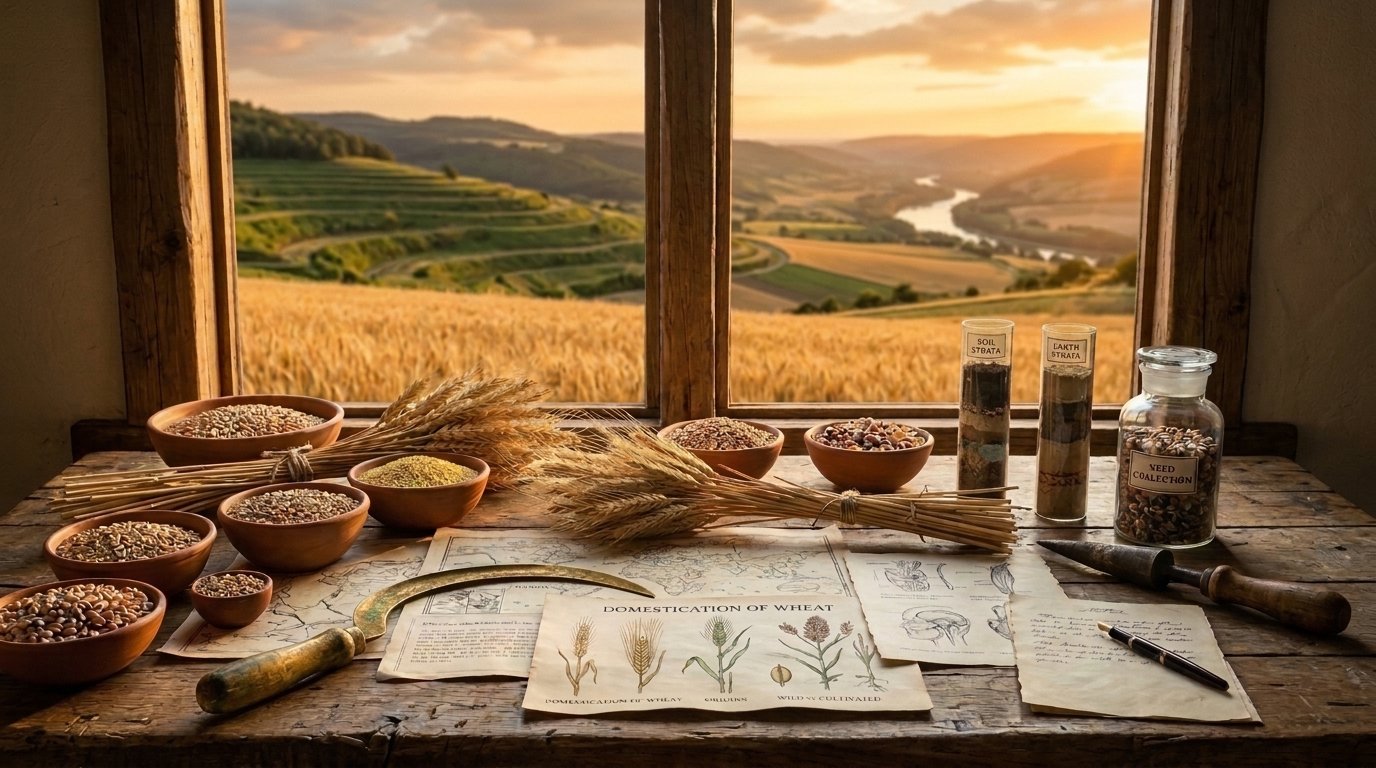
Today, global agriculture produces over four billion metric tons of food annually, nourishing more than eight billion people across vastly disparate climates. Yet behind the seamless convenience of modern supermarkets lies a breathtaking history of plant genetics, hydraulic engineering, chemical breakthroughs, and profound ecological balancing acts.
Below, we examine the history of world farming and agricultural development, exploring how ancient grain domestication sparked civilization, how technological revolutions multiplied food yields, and how regenerative agriculture works to sustain our modern state of living into the future.
1. The Neolithic Revolution: The Dawn of Settled Life (~10,000 BCE)
Around twelve millennia ago, as the last glacial period receded and global climates stabilized, independent human communities across separate continents simultaneously began domesticating wild flora and fauna:
- The Fertile Crescent (Southwest Asia): In the Levant and Mesopotamia, hunter-gatherers selected wild grains with non-shattering rachises (stems that held seeds intact until harvest), domesticating emmer wheat, einkorn, barley, lentils, and chickpeas alongside sheep, goats, and cattle.
- The Yangtze & Yellow River Basins (China): Sedge marshes in southern China gave birth to wet-rice paddies, while northern loess plains saw the intensive cultivation of drought-resistant foxtail and broomcorn millet.
- Mesoamerica & The Andes: Indigenous farmers performed extraordinary genetic feats, transforming a modest wild grass called *teosinte* into calorie-dense maize (corn), while Andean farmers cultivated over three thousand distinct varieties of frost-tolerant potatoes, beans, and quinoa.
The Civilization Catalyst: Grains could be dried, stored, and protected in granaries for years. This caloric surplus eliminated seasonal starvation, sparked dramatic demographic growth, and allowed portions of the population to specialize as builders, astronomers, healers, metalworkers, and scribes.
2. Hydraulic Civilizations: The Engineering of Irrigation
Early farming depended entirely on erratic seasonal rainfall. The emergence of the world’s first great imperial states was inextricably tied to the mastery of water engineering:
- The Nile Basin (Egypt): The predictable annual flooding of the Nile deposited nutrient-rich volcanic silt from the Ethiopian highlands across the river valley. Egyptian farmers perfected basin irrigation, allowing floodwaters to soak fields before draining back, turning arid deserts into the breadbasket of the Mediterranean.
- Mesopotamia (Tigris & Euphrates): Because river levels rose unpredictably during harvest time rather than planting season, Sumerian and Babylonian societies dug monumental networks of levees, sluice gates, and feeder canals to divert rushing water into holding reservoirs.
- Persian Qanats: Engineers in ancient Persia excavated subterranean aqueduct systems running dozens of kilometers from mountain aquifers, transporting pristine irrigation water through scorching deserts without evaporation loss.
3. The Medieval & Agricultural Enlightenment: Crop Rotations
For centuries, European agriculture was trapped in low productivity by the traditional “three-field system,” where one-third of all arable land was left fallow (unplanted) each year to restore depleted soil fertility.
In the 18th century, British and Flemish innovators pioneered the Norfolk Four-Course Rotation (wheat, turnips, barley, and clover). Instead of leaving land idle, farmers planted turnips (which broke weed cycles and fed livestock through harsh winters) and clover (a legume that captures atmospheric nitrogen and fixes it directly into the soil via symbiotic root bacteria). This simple biological rotation virtually eliminated European famine, provided year-round meat and manure, and fueled the demographic explosion required for the Industrial Revolution.
4. The Chemical Miracle: The Haber-Bosch Process (1909)
By the dawn of the twentieth century, global population growth was colliding with a catastrophic ecological barrier: a worldwide shortage of fixed nitrogen. While nitrogen makes up seventy-eight percent of Earth’s atmosphere, it exists as inert triple-bonded gas molecules that plants cannot metabolize.
In 1909, German chemists Fritz Haber and Carl Bosch cracked one of the greatest engineering feats in chemical history: synthesizing ammonia directly from atmospheric nitrogen and hydrogen gas under extreme pressure and heat. Today, synthetic nitrogen fertilizer generated by the Haber-Bosch process sustains nearly fifty percent of the human population. Without this single industrial process, approximately four billion people currently living on Earth could not be fed.
5. The Green Revolution: High-Yield Genetics
In the mid-20th century, catastrophic famines threatened hundreds of millions of lives across Asia and Latin America. American agronomist Norman Borlaug conducted thousands of cross-breeding trials in Mexico to develop semi-dwarf, disease-resistant wheat varieties.
Traditional wheat varieties grew tall and spindly; when heavily fertilized, their heavy grain heads caused them to collapse (lodge) in the wind and rot. Borlaug’s semi-dwarf varieties had stout, thick stalks that channeled fertilizer directly into massive grain yields without collapsing. Introduced to India and Pakistan in the late 1960s, these crops doubled national harvests in a matter of seasons, saving an estimated one billion people from starvation and earning Borlaug the Nobel Peace Prize.
6. How Modern Agriculture Sustains Civilization & The Regenerative Horizon
While industrial agriculture achieved historic caloric abundancy, it created profound ecological debts: topsoil loss at rates ten to forty times faster than natural formation, nitrogen runoff dead zones in oceanic estuaries, and deep groundwater depletion in major aquifers like the Ogallala.
To sustain human life over the next century, global agriculture is undergoing a profound paradigm shift toward regenerative agriculture and technological precision:
- Soil Microbiome Restoration: Shifting away from aggressive mechanical tillage preserves the delicate subterranean fungal hyphae and bacterial networks that sequester carbon and build organic soil matter.
- Cover Cropping & Polyculture: Keeping living roots in the soil year-round prevents wind erosion, retains moisture, and suppresses pests naturally without heavy chemical reliance.
- Precision Agriculture: Satellite imagery, drone sensors, and AI-guided micro-drip irrigation deliver water and nutrients down to the square centimeter, reducing waste by up to sixty percent.
- Vertical & Controlled-Environment Farming: Urban vertical hydroponic farms produce fresh produce using ninety-five percent less water and zero synthetic pesticides, freeing land for wilderness restoration.
Curated Book Vault: 4 Essential Works on Food, Soil & Society
To cultivate a richer scholarly understanding of how agriculture, soil ecology, and food production shape human civilization and planetary survival, our editorial desk recommends four landmark texts:
The Omnivore’s Dilemma: A Natural History of Four Meals — Michael Pollan
An illuminating investigation tracing modern food from industrial corn monocultures to organic pastures and wild foraging, revealing the ecological costs of how we eat.
Explore on Amazon →Guns, Germs, and Steel: The Fates of Human Societies — Jared Diamond
Pulitzer Prize-winning masterpiece proving that global inequalities arose not from biological differences, but from geographic luck in domesticable crops and animals.
Explore on Amazon →Dirt: The Erosion of Civilizations — David R. Montgomery
Geomorphologist David Montgomery demonstrates how historical societies from Mesopotamia to Rome collapsed when they exhausted their topsoil, offering urgent lessons for modern soil health.
Explore on Amazon →The Wizard and the Prophet — Charles C. Mann
A riveting exploration of two competing visions for Earth’s future: technological innovation (Norman Borlaug) versus ecological restraint and conservation (William Vogt).
Explore on Amazon →Frequently Asked Questions
When and where did world agriculture first begin?
Agriculture arose independently in multiple global regions roughly 10,000 to 12,000 years ago during the Neolithic Revolution. The earliest recorded centers were the Fertile Crescent in Southwest Asia (wheat, barley, legumes), the Yangtze and Yellow River valleys in China (rice, millet), and Mesoamerica (maize, squash).
Why was the Haber-Bosch process so critical to human survival?
Before the Haber-Bosch process (1909), agriculture was limited by natural soil nitrogen cycles. By synthesizing ammonia fertilizer from atmospheric nitrogen, it dramatically multiplied crop yields. Today, synthetic nitrogen fertilizer feeds approximately half of the world’s population.
What is regenerative agriculture and why does it matter?
Regenerative agriculture is a farming methodology focused on restoring topsoil health, rebuilding organic matter, enhancing biodiversity, and sequestering carbon. By avoiding heavy mechanical tilling and using cover crops, it ensures long-term soil fertility and water conservation for future generations.
Discover more on human history and world extremes in our Amazing World collection, explore how deep reading transforms the brain, and browse our scholarly journal.